Once we have our package.json files inside the image, we can use the RUN command to execute the command npm install. It would include the node server in the /dist folder when pushing to Azure. Usually the very first thing you do once you've downloaded a project written in Node.js is to install npm packages. This will ensure that your application has all its dependencies installed into the node_modules directory where the node runtime will be able to find them. Install it with npm install -g node-dev then run your application with node-dev server.

Js (or whatever the entrypoint file for your project is called if not server. js). Try nodemon module, Nodemon is a utility that will monitor for any changes in your source and automatically restart your server. For some projects we need to execute several scripts or npm commands simultaneously. We take the example of a JavaScript client and a Node.js server that need to be launched at the same time.

Another example is compiling files and launching a dev server next to it. So we will see the different ways to run several scripts in parallel. If you're going to create a program like forever (i.e. a long-running daemon process that receives user commands) then I'd highly recommend you do it this way. PM2 is a popular, advanced and feature-rich production process manager for Node.js applications with a built-in load balancer. Also, it supports easy management of application logs, and so much more.

All the three methods that we have discussed above to run node js server in the background runs only when the machine is running. When the machine is shut down all the running scripts will turn off. Eventually, you have to run the scripts again when the system is restarted.

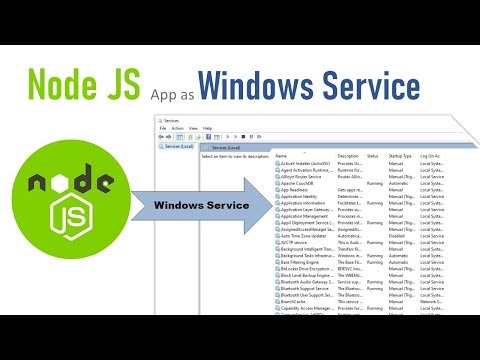
Luckily there is a NPM package node-windows which can install a node application as a Windows service. This service can be automatically started when the server restarts. If User Account Control is enabled on Windows you will have to give permission a few times to complete the installation.

Before we can run npm install, we need to get our package.json and package-lock.json files into our images. The first parameter tells Docker what file you would like to copy into the image. The second parameter tells Docker where you want that file to be copied to.

We'll copy the package.json and package-lock.json file into our working directory – /app. To interact with processes in the container, you are running Singularity containers in the foreground. Singularity, also lets you run containers in a "detached" or "daemon" mode which can run different services in the background.

A "service" is essentially a process running in the background that multiple different clients can use. To run services in a Singularity container one should use instances. A container instance is a persistent and isolated version of the container image that runs in the background. If you want to build a C/C++ library for your web app, you need its code to be part of your project. You can add the code to your project's repository manually or you can use npm to manage these kind of dependencies as well. Let's say I want to use libvpx in my webapp.

Libvpx is a C++ library to encode images with VP8, the codec used in .webm files. However, libvpx is not on npm and doesn't have a package.json, so I can't install it using npm directly. You can easily run scripts using npm by adding them to the "scripts" field in package.

Binaries of locally install packages are made available in the PATH , so you can run them by name instead of pointing to node_modules/. NodeJS is a popular web development framework to to build javascript-based applications. However, when you run a NodeJS app, it runs in foreground and does not allow you to run other processes while it is running. Sometimes you may need to run a NodeJS App or server in background so that you can do other things. In this article, we will look at the different ways to run NodeJS app in background. This image comes with Node.js and NPM already installed so the next thing we need to do is to install your app dependencies using the npm binary.

Please note that if you are using npm version 4 or earlier a package-lock.jsonfile will not be generated. PM2 is a daemon process manager that will help you manage and keep your Node.js application online 24/7. It's a production grade process manager that let's your node.js applications run in the background as microservices. PM2 also works in shell scripts, python and binary files. NPM as a package manager provides a lot capabilities outside the actual dependency management. You can leverage a built-in functionality to run scripts which enables the use case of NPM as a build tool.
Further, you can define a script within your package.json file that executes various tasks before finally starting your application. This will install the latest version of Git on the instance. Once installation is done, you are ready to clone your repository. Run the following command to clone your repository. Replace with your GitHub username, with the name of your node.js app repository and with the name of the folder you want to clone the repository into. This folder will be created under /home/ec2-user/.

Docker containers can be started, stopped and restarted. When we stop a container, it is not removed but the status is changed to stopped and the process inside of the container is stopped. When we ran the docker ps command, the default output is to only show running containers. If we pass the —all or –a for short, we will see all containers on our system whether they are stopped or started. If you are running services in containers you may want them to be started on boot, and shutdown gracefully automatically.

This is usually performed by an init process, or another supervisor daemon installed on your host. Many init and supervisor daemons support managing processes via pid files. Note that, rather than copying the entire working directory, we are only copying the package.json file. This allows us to take advantage of cached Docker layers. BitJudo has a good explanation of thishere. Furthermore, the npm ci command, specified in the comments, helps provide faster, reliable, reproducible builds for production environments.

That doesn't exclude PM2 as your process manager, because you can start your application using the pm2 command line utility and run the npm start command. It is designed to build and test an Angular project on a development server. However, if you want to run/keep your applications alive forever in production, you need a Node.js process manager such as PM2. Node-RED has also been packaged for the Raspberry Pi OS repositories and appears in their list of 'Recommended Software'.

Npm install all dependencies (via package. json) to the local node_modules directory. PM2 has a built-in load balancer which allow the node js app keep alive forever without downtime even the server restart. The app will run as long as you have the terminal open and you have not stopped it manually. But there's an easier way to do all this by using a process manager for node called PM2. We will focus on the auto-restart and background process functionalities of PM2 here. More functionalities in a later article on continuous integration.

There are several ways to start the app depending on how you have set it up. With your new package.json file, run npm install. If you are using npmversion 5 or later, this will generate a package-lock.json file which will be copied to your Docker image.

I have found Docker to be invaluable when working with Emscripten. C/C++ libraries are often written to work with the operating system they are built on. It is incredibly helpful to have a consistent environment. With Docker you get a virtualized Linux system that is already set up to work with Emscripten and has all the tools and dependencies installed. If something is missing, you can just install it without having to worry about how it affects your own machine or your other projects.
If something goes wrong, throw the container away and start over. If it works once, you can be sure that it will continue to work and produce identical results. I have a NodeJS application which has only typescript files in it, no js files. I want to run in on my server in the background. Tierney recommends that you not have a Node process manager running your application at all. Instead, have something at a higher level which watches multiple separate instances of your application.

For example, an ideal setup would be if you had a Kubernetes cluster with your app running on separate containers. Kubernetes can then monitor those containers and if any of them go down, it can bring them back and report on their health. Basically with this package you can run multiple node.js scripts in different ports. Also, this package has to feature to the logs of the script, stop & restart the script. We have published two different articles on Forever, please read them from the below links to get clear usage of it. This runs a predefined command specified in the "start" property of a package's "scripts" object.

If the "scripts" object does not define a "start" property, npm will run node server. Most Linux systems have systemd that allows you to define & manage services. In this case, you need to add the following command to the first line of your app.js file. It will set the runtime environment for your application.

Run the command pm2 start node-js-app.js to start the node js application as a daemon service. Of course pm2 start can also be used to start any app as a daemon servive. When you use gatsby new for the first time to create a new project, you are asked to choose your default package manager between yarn and npm. In part II, we'll take a look at running a database in a container and connecting it to our application. We'll also look at setting up your local development environment and sharing your images using Docker.

Since we ran our container in the background, how do we know if our container is running or what other containers are running on our machine? Just like on linux, to see a list of processes on your machine we would run the ps command. In the same spirit, we can run the docker ps command which will show us a list of containers running on our machine. The monday apps framework is a set of tools you can use to build on top of monday.com. A simple app might contain just a single board view, or use multiple views, widgets and integrations to create a set of functionality that extends across contexts. Forever is a command-line utility for Node applications written entirely in JavaScript.

It is meant to simplify your life in a production environment by managing Node processes and their configurations. You can use it on the command line or programmatically (via forever-monitor) within your Node code. Docker allows you to package an application with its environment and all of its dependencies into a "box", called a container.

Usually, a container consists of an application running in a stripped-to-basics version of a Linux operating system. An image is the blueprint for a container, a container is a running instance of an image. Package.json file that let you define various commands you can use to automate tasks related to your package. Lifecycle scripts greatly ease the lives of developers, especially in automating repetitive tasks. It is a useful improvement, especially for those in mixed yarn/npm environments or intending to migrate their existing projects to Yarn.
An alternative solution is to encapsulate more of these problems with Docker and Docker's smart approach to caching. Docker executes Dockerfiles step-by-step and assigns the result of each step an image of it's own. These intermediate images are often called "layers".

If a command in a Dockerfile hasn't changed, Docker won't actually re-run that step when you are re-building the Dockerfile. Instead it reuses the layer from the last time the image was built. In the majority of cases, the entry point to a web project is npm'spackage.json.

By convention, most projects can be built with npm install && npm run build. Collaboration is really easy because of docker. The environment of the application remains compatible over the whole workflow. This implies that the app runs precisely the same way for the developer, tester, and client, through development, staging, or production server.
Next, start webpack's development server using the npm run watch command. Now, when you modify a script or PHP file you can watch as the browser instantly refreshes the page to reflect your changes. I tried using the npm package called forever but it only works with js files as it doesn't understand the typescript code. To make your new application run in the background, freeing up the command prompt, use PM2 to serve it, as shown. PM2 also aids common system administration tasks such as restarting on failure, stopping, reloading configurations without downtime, and much more.

To build and run your generated application in a local development environment follow this tutorial. VS Code is used for demonstration in this article, but the process can be done on any IDE or directly in the command line with npm CLI. The configuration file of webpack, which contains the configuration of the project packaged and running in the development environment. As it turns out, Azure is already doing this. If we don't push a pm2 ecosystem file to Azure, it will start the application with our package.json file start script and we can run directly against Node.


No comments:
Post a Comment
Note: Only a member of this blog may post a comment.